

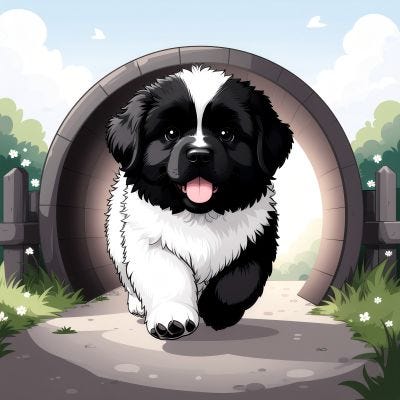
Today we are going to do a leash lesson that is pure fun. It’s likely not required for every dog (wow, I mistyped that the first time as “god”…). Well, it is Sunday, so it is also a reminder to say your prayers before and after leash lessons, I guess.
Tunnel
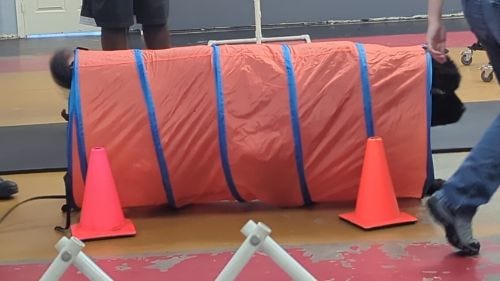
Today’s leash lesson is going to be the tunnel. This is actually one of our agility entry points for leash lessons, and it’s something I’m working on with both Crokell and Dante. Dante does this way faster than Crokell, but Crokell is more balanced about how he goes through each tunnel.
For most dogs, tunnels can be a bit noisy, fast, and weird to go through. One of the hardest things for many dogs is that when they enter a tunnel, they can no longer see you. Plus, the tunnel changes all sounds and has an odd texture and smell. Each of these makes it difficult for some dogs. Other dogs (I am looking at you, Dante) just don’t care and are happy to run into and out of a tunnel as fast as their little paws can carry them.
Versions of the Tunnel Command
Now, there are a few different versions of the tunnel command in agility training, but for this lesson, we’ll focus on one simple version and build from there.
Tunnel: this is what I used to send a dog through a tunnel…
Through: This is what I used to send a dog through someone’s legs. Some people use this as their tunnel command.
As usual, you can use any command, but I provide some common options.


How does this work for our Chaos Critters?
Hmm. Dante rocks it. Actually, he is not sure why we don't do tunnels every day.


Crokell is not sure why we need tunnel but will go through them just fine. He would rather have a car ride (hint, hint).
Teaching Your Newest Critter to Tunnel
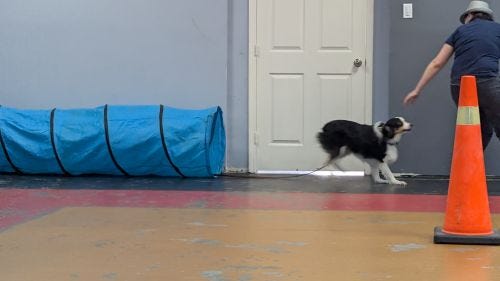
The setup is important. Make sure the dog is comfortable. The first try should be on flat ground. The tunnel should be short and straight, and big enough for the dog! This is important. Crokell is huge compared to Dante, so he has to have a large tunnel. Trying something small would be mean. On the smaller dogs, you can start smaller, but you could always start big and go smaller as they get comfortable.
Still, it is best to start small (or rather big but short). Then get longer tunnels as your critter builds up confidence. For starters, get a straight tunnel and make sure the tunnel is fully anchored. For this, you want a short tunnel where the dog can see you at the other end when you’re calling them through.
As with all leash lessons, we will start on leash. Now, if you are looking at me going, “But tunnels and leashes don’t mix,” shh. Don’t get your hackles up yet. I have a method to my madness. And no, I am not telling you to pull the dog through.
If your dog is scared, get them to touch the tunnel. You reward them. Change it up, do something else, then come back. This should not be repeated one right after the other. Although, if it was a really bad one, you might want to repeat it, but more gently, shortening it, or making sure the dog has some sort of success at the end.
Incentives
You’re going to do this on leash and it’s going to be you and, hopefully, a partner. Have the partner walk the dog to one side of the tunnel, and you (since your dog loves you best [Tod is sad because it’s true. Although, Crokell might love me at least as much as Anna. -Tod]) are going to be on the other end of the tunnel. You then call the dog to you. Note, you can have the tunnel really short for this. They are almost just stepping through a hoop. Pet them up and maybe play some tug. Then you lengthen the tunnel when you repeat it.
Corrections
Hopefully, your pup will come. If they don’t, the leash at least helps keep them from going around the tunnel, and you can use it to help guide them to you and then play with the pup, when it is through. This next part is particularly crucial, when dealing with a nervous dog attempting to avoid the situation. If it requires waiting, then wait. You aren’t pulling so much as preventing them from running around your backyard. But also check your setup. Make sure your tunnel is not wobbling and rolling, because sometimes they’re fearful more because your setup is bad.
Session Length and Style
Short, short, and shorter. Actually, that isn’t true for Dante, but it is for Crokell. Because the setup is longer and Dante LOVES tunnels, I tend to do these as longer sessions, going a whole 15 minutes of games and such in the backyard before I switch out dogs.
Dante LOVES tunnels and thinks I should send him through whenever one is out, which actually means sometimes I put them out just as a distraction.
For Crokell, I try to do three to five reps, with maybe some other couple of things going on in between. Then he is bored and warm and wants a nap.
Tunnel Games
As your dog gets better trained, you can have them sit, stay, and do other things, and then call them through without the second person. At the beginning, I just used the “come” to get them to go through the tunnel; later I added the tunnel command and started slowly giving it from different angles.
This is where the game comes in, and where I have the most fun. So far, we are working on these three with Dante.
Tunnel to me: This is the most basic game with a tunnel.
Tunnel get it: This is sending them to a tunnel to get a treat or something cool.
Tunnel and run: This is sending them through a tunnel and then having them run through, join you on the other end, and keep going with you.
Consider mixing in other simple obstacles or even changing how the dog goes in. For me, changing left and right can be a huge change (because I barely remember my left and right) and always think of left as dog side, and right as the other side…
So, I have to work on that.
Right vs. left side
This came up in one of my sessions with Dante!
In training class, we usually walk up to the tunnel with the dog on our (checks and rechecks) left side. Then tell them “tunnel” and keep walking. Almost every dog got really confused when they had to approach the tunnel on the right side of the trainer.
I heel so much on the left that Dante is confused when I try to send him from the right or have him work on the right. (Nope, it isn’t my fault for not knowing the difference, nope. Not at all.)
Hence, that is what we will need to practice doing more on the right. You should be able to run the tunnel with your dog on the right and your dog on the left. It will be hard the first few times. You still need to have a clear cue for left and right, and you need to be able to tell your dog on which side to work on.
We might cover this in a different leash lesson — although having Tod teach me left and right might take more than a few treats and LOTS of corrections.
How often to practice?
The tunnel is sort of part of flatwork (aka not jumping), but it is still an obstacle, so I only really do this on the weekends. It has to do with the time to set up, because pulling out the tunnel takes a hot minute (at least for me). If you already have an agility course set up in your backyard, whoop! Go use it. I envy you, and you’re likely more of an expert at this than I am. Feel free to make comments about what I’m doing wrong, because I can’t get better without corrections.
Note: At this time, I haven’t competed in agility yet, but I’m really excited to do that sometime this year or next year with Dante. One of the things I read is that flatwork is the most important for agility. So while I’m going to show some stuff on the obstacles, all my training this year for almost everything is going to be flat work, where the only parts where I do the jumps or the tunnels is going to be once a week, and it’s going to be a sort of exciting play thing with him because he loves it.
Other equipment you can pair the tunnels with: wings, low jumps, or a mat. Have fun and don’t worry too much. We train for life, not just for competition.
This is a great Saturday or Sunday practice where we can just have fun and then flop over and pant.
Duration, distance, and distractions
Now, what do you want to use? How do you get started with this? The duration is going to be not just the length of the sentence or of the training session, but the duration you have of the tunnel itself. It’s both distance and duration.
Distance: This is how far away you are sending them to the tunnel. You’re going to start right in front of it, and then slowly you’re going to be further and further away when you’re sending them through it. Changing the angle here will change what they do.
Duration: This is the length of the tunnel. Start short, then lengthen it as your dog becomes more confident. Also, this is the time you wait, or the time of the session. Ahh. It can be too many things. Hides head in the toy box.
Distractions: Having the jumps out, another dog, or just noise can be a big deal. Shorten the length and make sure they are ready to go. I also consider angle a little on distractions as well. If you only train for the left, sending from the right is a huge issue and can either be considered a distraction or a distance issue…
Remember to only strengthen one “D” at a time: distance, distraction, or duration. Choose one for that session.
I am trying to review this each weekend for now, but you are going to find this is something you can do if you’re in an agility group during the week, cool. Every time you do your agility session, you’re going to want to really work on tunnels at least a bit.
The biggest thing is that this builds up confidence, especially for dogs that are scared of stuff. It’s right to expose them to things and get them used to stuff.
Homework
Get a tunnel and find the other side. I mean, really, just have fun. Maybe you can even climb through yourself and your critter might follow.
Chaos Tip of the Week
Remember, the light might be an oncoming spaceship zooming to freedom, or it might be an opening to a new world or plane of existence. Just make sure you’re prepared to jump on through whatever is incoming.
Critter Question of the Week
How do you go through your own tunnels? Do you crawl, stall, or run through like a crazy Dante menace?
Thank you all. Have a nice day and happy leash lessons. Find the tunnel to your own heart.
~Anna, Tod, Crokell, and Dante
More IP Writing on the Way!
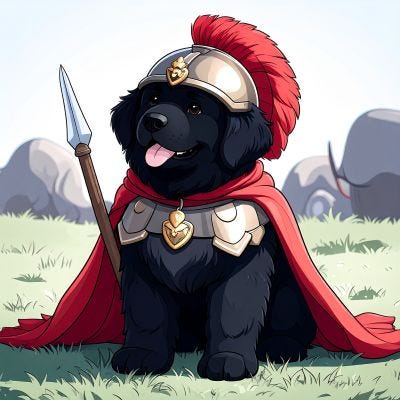
Anna and I are please to announce that our story, Family Honor, has earned a spot in the Annals of the Auran Empire anthology. Arbiter of Worlds has a blog post with the complete author list and more details. The anthology is set in the Adventurer Conqueror King System Imperial Imprint RPG universe of the Auran Empire. (Think Fantasy Rome.)
Crowd funding opens June 8th, and you can sign up to be reminded via BackerKit now!
https://www.backerkit.com/call_to_action/8b8be898-82a5-4dc9-868d-aa9a9b449f6e/landing
We’re pleased to see our fellow Alpha Mercs joining us: Zane Voss, Sam Robb (the first anthology we were in was also with Sam), B.K. Gibson (who also gave great developmental feedback during edits https://coldlightrpgpress.weebly.com/), and Nathaniel McIntyre.
We think our story has the most interesting one liner in the announcement:
“Family Honor” by A. Kristina Casasent, featuring a Ring Against the Wolf, tells the story of a Tirenean nobleman struggling with the challenge of producing an heir with his new wife.
For more details, checkout the Arbiter of Worlds blog!

Are you dyslexic? If not, then hold your hands up in front of you, palms out. Fold down the last three fingers, and stick your thumbs out at right angles, like a director looking at a frame. You will have 2 right angles. One will form a capital L, one will not. The one with the L is the left hand. If you are dyslexic, this may not work! It's slow at first, but gets faster over time and practice.
As for working on the right, I train my dogs to heel on both sides, using "Right Heel" and "Left Heel", and it has worked well. I love to watch agility - it is so beautiful to see the excitement and hard work coming to fruition.
Congrats on making it into the RPG antho! 👏
Tunnels for me? I slow down to make sure I don't scrape the sides ever since I took the one-way tunnel into Whittier, AK. The Army chiseled that tunnel through a mountain, and it's very rough. 😨